
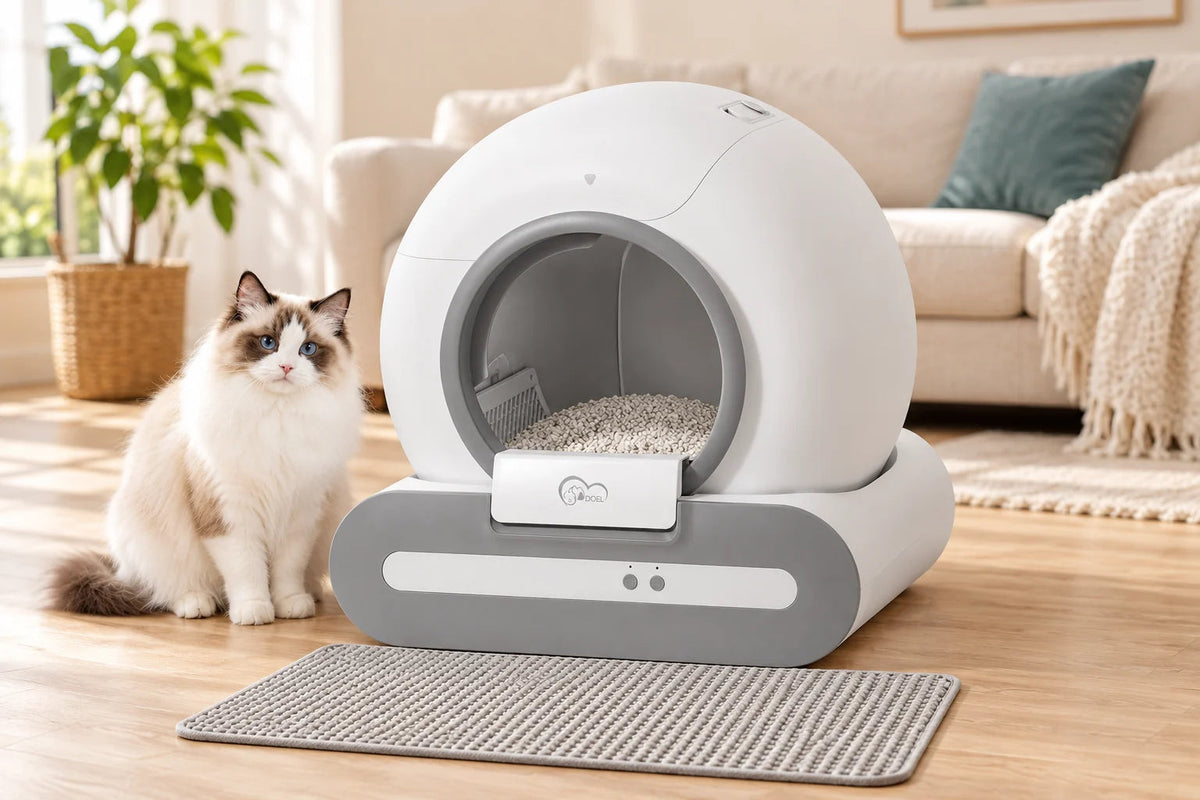
A self-cleaning litter box uses a powered mechanism to separate waste from the material left for your cat to use. Sensors and controls determine when operation is permitted; the mechanism moves waste to a compartment that you empty.
The details differ by machine. A rotating sifter, a rake and a system using a dedicated tray are not interchangeable, and they do not necessarily use the same litter or cleaning sequence.
Rotating and tilting sifters
In a clumping-litter sifter, movement brings the litter to a screen or sieve. Clean granules pass through the intended openings, while larger clumps and solids are separated and moved toward the waste compartment. The chamber then returns to its normal position.
The goal is to preserve usable litter while removing waste, not to break clumps apart. That is why granule size, clump strength, the fill mark and the permitted cleaning delay affect performance.
Rakes and moving screens
A rake travels through a litter area to collect or move waste toward a receptacle. The geometry and approved litter are specific to the design. Access around the rake may be part of the cleaning procedure.
Some products use a dedicated crystal-litter tray, while others use an approved clumping formulation. “Rake” is not a universal instruction to use crystals, and a crystal-tray system should not be described as a conveyor belt unless it actually has one.
Detection and delays
A machine needs to establish the conditions required for a cycle. Depending on the model, it may use weight, position, optical detection or other systems. Follow the documentation for the exact version rather than assuming that every product has the same combination.
A delay after use may allow clumps to form and the cat to leave the area. Available delays and interruption behavior vary. Do not replace them with a universal timer from an online guide, and never bypass a detector to make a machine run.
A typical cycle, with model-specific differences
- Ready state: the unit is assembled, positioned and filled as directed.
- Use is detected: the machine monitors the conditions described in its manual.
- The permitted delay runs: cleaning waits until the required conditions are satisfied.
- Waste is separated: the mechanism sifts or moves material to its receptacle.
- The unit returns to ready: the chamber or rake reaches its normal position.
- Optional records appear: a connected model may show a cleaning event or activity data.
This sequence explains the concept; it is not a substitute operating procedure for any particular machine. Some products have additional steps or do not include connected records.
What changes when the litter is wrong?
| Observation | Questions to check in the manual |
|---|---|
| Clean litter enters the waste compartment | Is the litter approved, correctly sized and below the fill mark? |
| Clumps remain on the liner | Is the formulation suitable, the permitted delay correct and the liner clean? |
| A cycle pauses or fails | Is there an error, an obstruction, a cat nearby or a setup issue? |
| The box smells after a successful cycle | Is the collected waste full, is residue present, and are approved filters due for attention? |
Stop operation as directed before investigating. Do not reach into moving parts, force the chamber or dismantle electrical components.
How the current DOEL examples differ
The DOEL Ti Pro lists automatic, timed and manual cleaning modes, app and touch controls, and records of cat weight, visit frequency and duration. The DOEL Ti+ lists app control and removable components. Both currently specify a 2.3 ft³ usable interior and 2.4 GHz Wi-Fi for app connection.
The DOEL SLB-A lists a 78 L chamber with a separate 4 L waste compartment. The distinction matters: the chamber is the operating space, while the waste compartment determines where separated material collects. Neither figure states how many days you can ignore the unit.
Why cleaning the machine still matters
Automation moves material but leaves surfaces, seals and removable parts that need attention. Empty waste according to actual condition and the manual. Clean permitted components, dry them before assembly and keep water away from the electrical base.
Continue observing your cat as well. The AAHA/AAFP litter-box guidance addresses access, placement and regular care; choosing an automatic mechanism does not remove those needs.
Frequently asked questions
Does a self-cleaning box wash the litter?
Most sifting designs separate waste rather than washing and sterilizing the remaining litter. Check the mechanism of the specific product.
Why does the box wait before cleaning?
A model may include a delay as part of its operating sequence and to allow suitable clumping. Use the options and instructions provided for that machine.
Does a completed cycle mean the box needs no attention?
No. Check the litter area, waste compartment and normal ready position. Records support inspection; they do not replace it.