
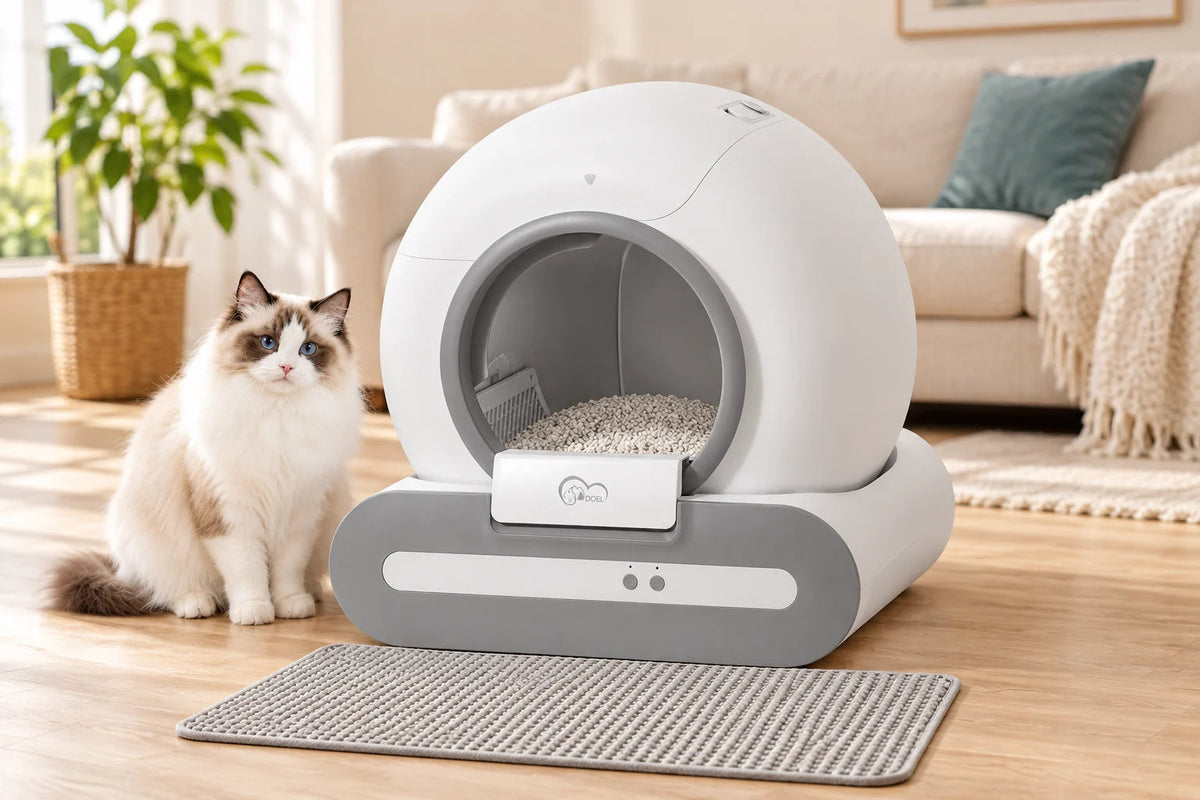
The best litter for a self-cleaning litter box is the litter that the exact machine is designed to use, that sifts reliably and that your cat accepts. Crystal litter is not a universal upgrade, and a bag labelled “automatic” is not enough to establish compatibility.
Check your box's manual before buying a large supply. Litter texture, granule size and clumping behavior affect the cleaning mechanism; changing those can change the way the unit operates.
Match litter to the mechanism
| Litter | Where it may fit | Check before use |
|---|---|---|
| Clumping bentonite clay | Many rotating or sifting machines | Approved particle size, fill level and time allowed for clumps to form |
| Clumping tofu or other plant-based litter | Machines explicitly listing that formulation | Granule length, sifter clearance and whether clumps stay intact |
| Non-clumping crystal litter | Models specifically designed for crystals or a particular tray | Exact tray and refill requirements; do not substitute into a clumping system |
| Wood or other pellets | Pellet-compatible systems | Whether pellets can pass through or obstruct the mechanism |
| Mixed litter | Models that expressly permit the particular mixture | Both ingredients and their proportions, not merely the word “mixed” |
A rake does not automatically imply crystal litter, and a drum does not mean every clumping formula will work. Read the requirements for the individual product.
Why clump strength and sifter size matter
A sifting machine needs the clean granules and waste to separate in a predictable way. Weak clumps can crumble; sticky clumps can remain on a liner; oversized particles can fail to pass through the sifter. An overfilled chamber adds another variable.
Start with a small amount of approved litter and observe complete cycles. Check whether clean litter is being thrown away, clumps remain behind or the unit reports an interruption. Stop and consult the manual if operation is abnormal. Do not solve a compatibility problem by disabling a sensor or forcing a mechanism past a blockage.
Dust, scent and your cat's preference
Choose within the machine's compatibility requirements, then consider the texture and scent your cat already accepts. “Low dust” does not mean no maintenance: dust can still collect around sensors and openings.
The Cornell guide to house soiling discusses unscented litter and gradual changes. A formula that performs mechanically is not a success if your cat avoids the box.
Do not add perfume, household deodorizer, oils or other ingredients on the assumption that they are compatible. Extra powder can alter texture and dust levels. Follow both the litter and machine instructions.
Current DOEL compatibility examples
The current DOEL Ti Pro listing specifies clumping litter. The DOEL SLB-A also specifies clumping litter, with particles under 15 mm recommended in the current store information.
Those statements do not mean every clay, tofu, crystal or pellet product has been tested in either box. Check the supplied manual and ask support about a particular formulation if the listing does not resolve the question. Current model documentation takes priority over general advice in this guide.
Keep the litter at the indicated level
Use the machine's fill mark rather than a universal depth borrowed from a manual tray. Overfilling may send clean litter into the waste compartment or affect the mechanism; too little litter can leave waste against the liner.
Top up only when appropriate, checking the level with the chamber in the position described in the manual. Keep replacement litter dry and close its packaging after use. Empty and clean the chamber as directed; adding fresh litter indefinitely does not remove accumulated residue.
Introduce a change carefully
Keep a familiar manual tray available while you change the automatic box's litter. If a gradual mixture is approved by the machine and litter manufacturers, follow that guidance. Otherwise offer the new litter in a separate suitable tray to establish whether your cat accepts it, rather than mixing incompatible materials inside the machine.
Avoid changing the box, location and litter all at once. If your cat stops using the arrangement, restore an acceptable alternative and seek advice about the change rather than waiting for the cat to adapt under pressure.
Compare running cost without wasting supplies
Record how much litter you add, how much clean litter appears in the waste drawer and how often the chamber needs a full change. A cheaper bag can cost more in practice if a machine discards it inefficiently. Buy a larger pack only after compatibility and acceptance are established.
Dispose of used litter and liners according to the product instructions and local waste requirements. A “natural” or plant-based label is not a reason to flush used litter.
Frequently asked questions
Is crystal litter best for every automatic box?
No. Use crystals only in a system that specifically permits them. Machines that separate clumps generally need an approved clumping litter instead.
Can I use tofu litter in a rotating litter box?
Only if that model permits the type and particle size. The performance of one plant-based formula does not establish that all others are compatible.
What should I do if litter keeps sticking?
Check the approved formulation, fill level, cleaning delay and maintenance instructions. If the problem continues, contact support rather than forcing or modifying the machine.