
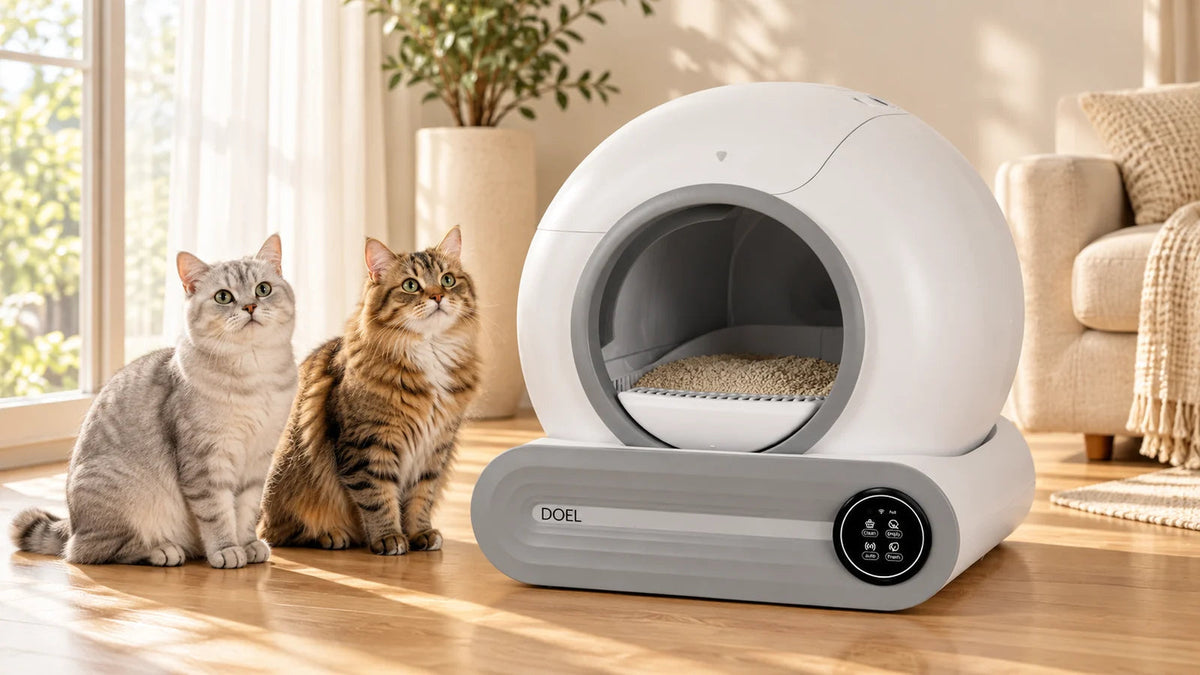
The best self-cleaning litter box is the one your cat can use comfortably and that you can keep working correctly. A large advertised volume, an app or a long list of sensors cannot answer those questions on its own.
This DoelPet guide is a decision framework, not an independent test ranking. It uses current store specifications for product examples and separates measurable features from questions you should resolve with the seller before buying.
Begin with your cat, then the features
Write down the age, weight and body size of every cat that could reach the box. Note whether any cat needs a low entry, avoids covered trays or dislikes unfamiliar noise. In a multi-cat home, check access and competition as well as waste capacity.
A useful starting order is:
- Eliminate products that do not meet the manufacturer's age and weight limits.
- Check the opening, usable floor area, headroom and entry height.
- Confirm compatible litter, power and network requirements.
- Read how you will empty, disassemble and clean the unit.
- Compare current price, consumables and support after the practical requirements are met.
If a key measurement is absent, ask for it. A photo of a large cat sitting at the entrance does not establish comfortable use inside.
Compare types without assuming one always wins
| Design | What to investigate | Possible tradeoff |
|---|---|---|
| Rotating or tilting sifter | Usable chamber space, sifter compatibility and interruption behavior | An enclosed shell may not suit every cat |
| Rake or moving-screen system | Required litter, rake access and cleaning procedure | Waste or litter may collect around the mechanism |
| Open-top automatic design | Pan dimensions, clearance and exact cleaning motion | An open top does not establish that all cats meet the operating limits |
| Conventional manual tray | Room, entry and a sustainable scooping routine | Requires manual waste removal |
The mechanism tells you what maintenance to investigate. It does not establish a universal winner for odor, safety or acceptance.
Current DOEL litter-box examples
| Model | Current listed capacity | Other listed details to compare |
|---|---|---|
| DOEL Ti+ | 2.3 ft³ usable interior, about 65 L | App control; 6.9 in entry height; listed cat weight up to 18 lb |
| DOEL Ti Pro | 2.3 ft³ usable interior, about 65 L | Automatic, timed and manual modes; app and touch controls; listed cat weight 2.2–19.8 lb |
| DOEL SLB-A | 78 L chamber; separate 4 L waste compartment | App cleaning settings; clumping litter; listed cat weight 3.3–18 lb |
Capacity labels are not interchangeable: a chamber volume is not a waste-bin volume, and neither is a direct measurement of turning space. Product pages show the current price and availability. Read the selected version's manual for all suitability and operating conditions; the table is not a recommendation to use a box with a kitten merely because it reaches a listed weight.
Look beyond the app screenshots
App functions vary. Decide whether you want scheduling, manual controls, activity history or specific notifications, and verify that each is present. All three examples above list 2.4 GHz Wi-Fi for app connection; do not assume 5 GHz support because a different household device has it.
Ask what remains available if the internet disconnects. Check which settings require the app and how you stop or inspect the machine locally. An activity record is useful information, but it is not an assessment of your cat's health.
Work out the maintenance and ownership cost
Read the cleaning instructions before deciding a machine will save you work. Consider whether you can lift the removable chamber, reach the drawer and clean permitted parts in your home. Keep the electrical base out of water.
List compatible litter, liners, filters where fitted, replacement parts, shipping and the return terms. Compare current amounts rather than a discounted purchase price alone. Waste should be inspected and removed according to condition; a claim about the maximum number of days between emptying is not a care plan.
Give the cat an acceptable alternative
Keep a familiar tray during the introduction and watch whether the cat actually uses the new arrangement. The ASPCA's guidance on litter-box problems discusses box preference, access and returning to a traditional tray when a self-cleaning one is avoided.
A successful purchase should improve a routine your cat accepts. If the machine is technically impressive but the cat avoids it, change the arrangement rather than forcing the switch.
Frequently asked questions
Which self-cleaning litter box is best for every household?
There is no universal best model. Compare the cat's suitability, physical fit, litter, maintenance and support before optional technology.
Does a larger litre figure mean a better box for a large cat?
Not necessarily. Check what the figure measures and obtain usable dimensions. Weight limits and entry access remain separate requirements.
Will an automatic box remove every litter-care task?
No. You still inspect the box, empty the waste compartment, replenish litter and maintain the equipment as directed.