
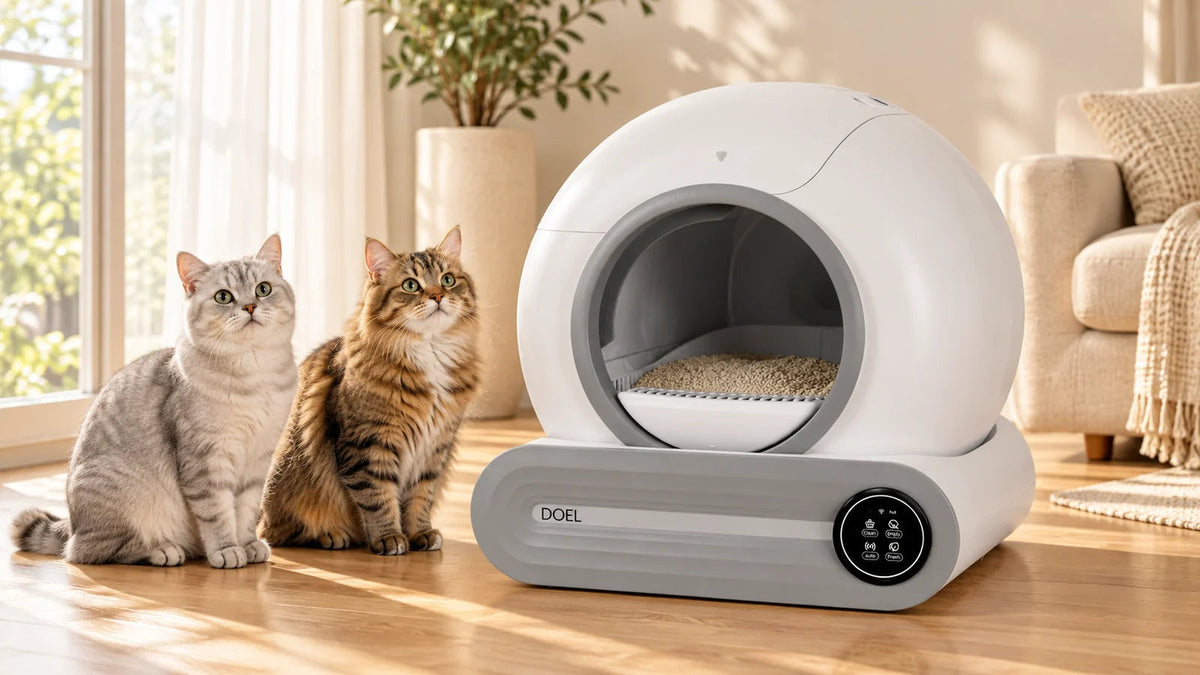
A self-cleaning litter box can help with waste removal in a multi-cat home. It cannot stop one cat guarding a doorway, provide an alternative while a cycle runs or establish that every cat is using the box comfortably.
Plan the toilet locations first, then decide where automation fits. The number of cats a machine is advertised to accommodate is not the same question as how many accessible toilet options the household needs.
How many litter boxes do multiple cats need?
The AAHA/AAFP litter-box guidance gives one box per cat plus an additional box as a general starting point, with social grouping and placement also relevant. For two cats, that starting point is three boxes.
Do not reduce access simply because a machine removes waste more often. The goal is that each cat can reach an acceptable toilet without waiting, being cornered or passing a cat that blocks it.
Spread locations rather than lining up machines
Two boxes side by side can still be blocked by one cat at the same doorway. Look at the household layout: quiet approaches, escape routes, floors the cats use and places where conflict occurs.
Keep toilet areas separate from feeding stations. Avoid placing the only box behind a noisy appliance, a door that may close or a narrow passage. A large capacity cannot correct a location the cat will not enter.
| Household issue | What to investigate |
|---|---|
| One cat waits outside the room | Access may be guarded or the route may feel unsafe |
| A cat uses only the manual tray | The machine, litter, location or introduction may not suit it |
| The drawer fills quickly | Actual waste load and emptying frequency, not just advertised capacity |
| App records are hard to assign | Whether the product can reliably distinguish these particular cats |
| A cat begins toileting elsewhere | Restore acceptable access and obtain veterinary advice |
Check every cat against the limits
Record each cat's age, weight, body size and entry needs. Consider every cat that could access the machine, including kittens and visiting pets. If a cat falls outside the manufacturer's conditions, address that access before enabling automatic operation.
A shared machine also needs to fit the largest cat physically while meeting the requirements for all users. Chamber volume alone does not establish that either the smallest or largest cat is eligible.
Waste capacity is not a number of unattended days
A waste compartment fills according to the actual cats, litter and use. More visits generally mean more material to inspect and remove; a published maximum interval should not be extended to a larger household without evidence.
Start by checking the drawer daily. Learn the real fill rate, keep liners fitted correctly and empty before residue or a full compartment affects operation. Continue checking even if notifications are available.
The current DOEL SLB-A lists a 78 L chamber and a separate 4 L waste compartment. The 78 L figure does not describe the garbage drawer. The DOEL Ti Pro lists 2.3 ft³ of usable interior, automatic, timed and manual cleaning modes, and activity records. These are useful comparison details, not proof of a fixed cat-count allowance or a maintenance-free period.
Be realistic about multi-cat records
Some products record weight and visits; the way they assign those events varies. Do not assume that recording a weight means a machine can reliably identify cats of similar weight or independently confirm every cat's health.
Use direct observation alongside records. If a cat's toileting changes, speak with a veterinarian. Avoid waiting for an app to classify the problem.
Introduce the machine while keeping alternatives
Let each cat investigate according to the product's transition instructions. Keep the familiar trays and avoid changing all locations and litter at once. One confident cat using the machine does not mean the rest have accepted it.
Watch entrances and routes, not only the chamber. A more cautious cat may approach only when another cat is absent. Adjust the arrangement to improve access rather than trying to make every cat share the same preferred location.
A care plan for the household
- Assign who checks litter condition, the waste compartment and errors each day.
- Record the approved litter and liner requirements so replacements are consistent.
- Keep a suitable alternative available while a machine is cleaned or unavailable.
- Review the arrangement after adding a cat or changing rooms.
- Arrange human care when travelling; automatic cleaning does not replace a person checking the cats.
Frequently asked questions
Can one automatic box be part of a two-cat setup?
Yes, but do not assume it should be the only toilet option. Plan access around the cats and household layout as well as the machine's permitted use.
Does a larger waste drawer mean I need fewer boxes?
No. Storage capacity and behavioral access solve different problems. A cat still needs an acceptable place to go when another location is unavailable.
Can activity logs tell me which cat is unwell?
Logs may help describe changes, but identification and interpretation have limits. Observe the cats directly and ask a veterinarian about concerns.